
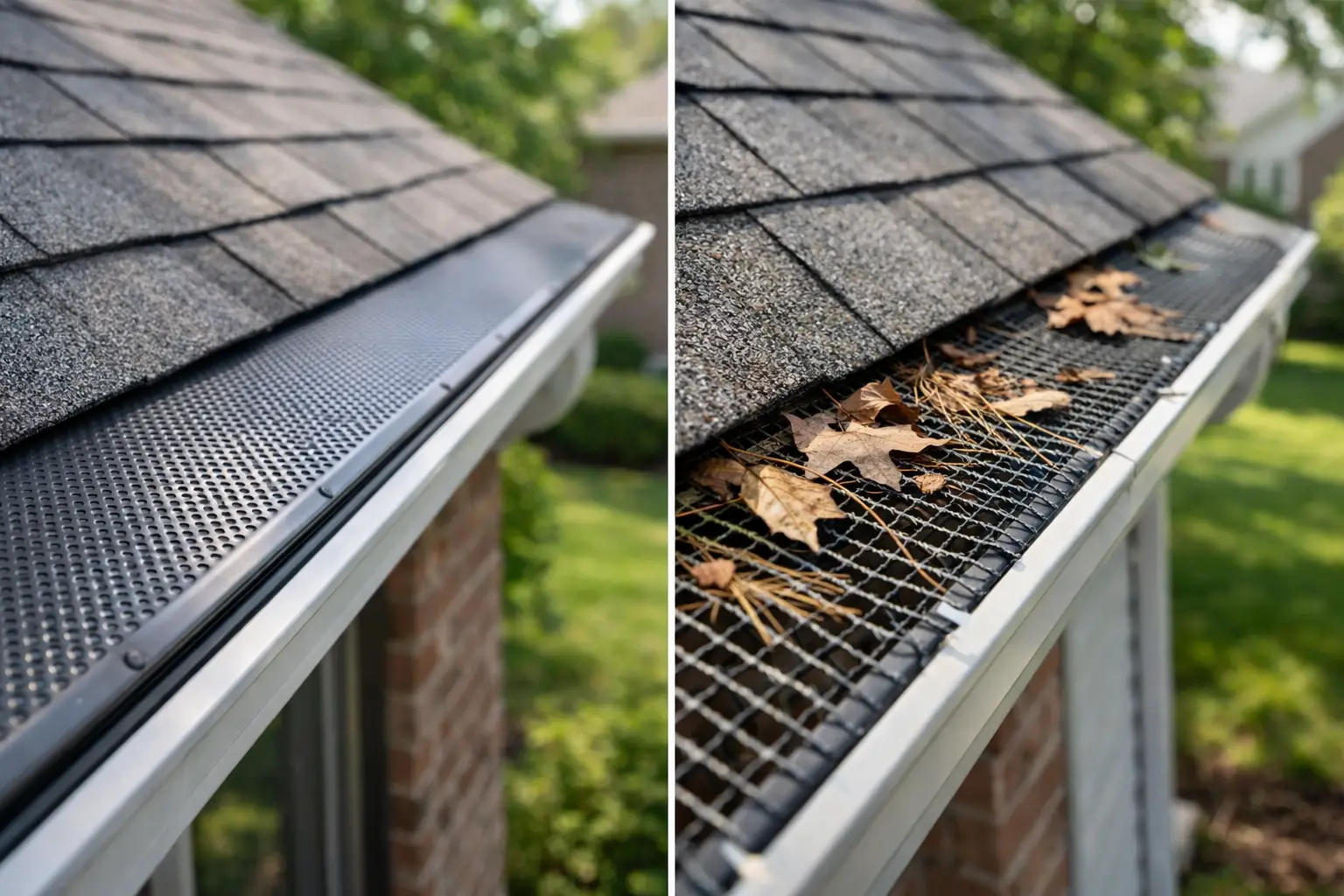
Yes, for most Utah homes, gutter guards are worth the investment, but only the right type installed correctly. Utah’s mix of heavy mountain snowpack, spring runoff, and dry-summer pine needles clogs open gutters fast, and clogged gutters are a leading cause of ice dams, fascia rot, and foundation water damage. The wrong guard, though, can trap ice and make winter problems worse.
How Do Gutter Guards Work?
Gutter guards are covers or inserts that sit over or inside your gutter channel, letting water in while blocking leaves, needles, and larger debris. Most systems rely on one of three mechanics: a mesh screen that filters particles, a curved surface that uses water’s surface tension to pull it into the gutter while debris slides off the edge, or a porous foam/brush insert that physically screens out material as water passes through.
The goal is simple — keep water moving off your roof and away from your home’s structure without you climbing a ladder every few months. On paper, every product does this. In practice, performance varies a lot once Utah’s climate gets involved.
Do Gutter Guards Help With Snow and Ice Dams?
This is where homeowners along the Wasatch Front and in Southern Utah’s higher elevations need to slow down before buying. Gutter guards can reduce ice dam risk indirectly — clean gutters drain faster, so less standing water freezes into the ice ridges that back up under shingles. But guards don’t stop ice dams caused by attic heat loss, which is the real driver behind most Utah ice dams.
Some flat mesh and reverse-curve guards can actually work against you in heavy snow: snow load sits on top of the guard, melts from roof heat, refreezes at the cold edge, and ices the guard shut before water ever reaches the gutter. In our experience serving both Northern Utah’s deep-snow canyons and Southern Utah’s lighter but still freezing winters, guards paired with proper attic insulation and ventilation perform far better than guards alone.
Types of Gutter Guards Compared
Not all gutter guards handle Utah’s freeze-thaw cycles and dry pine debris the same way. Here’s how the four main types stack up.
| Guard Type | Best For | Pros | Cons |
|---|---|---|---|
| Micro-Mesh | Fine debris, pine needles, seed pods | Blocks even small particles; durable; works well under most Utah roof types | Higher upfront cost; needs occasional surface brushing |
| Reverse-Curve / Surface Tension | Heavy leaf-fall areas, low-maintenance goals | No screen to clog; sheds large debris automatically | Can shed water off the roofline in heavy downpours or ice buildup; less effective on low-slope roofs |
| Foam Inserts | Budget upgrades, DIY installs | Inexpensive; easy to install | Degrades in UV/freeze-thaw cycles; can absorb water and freeze solid in winter |
| Brush Inserts | Light debris, temporary fix | Low cost; simple to remove and clean | Traps fine grit and seeds inside gutter; least effective for heavy Utah runoff |
What Gutter Guards Don’t Solve
Gutter guards are not a substitute for correctly sized, properly pitched gutters, sound fascia and soffit, or good attic ventilation. If your gutters already undersize spring snowmelt runoff, adding a guard on top won’t fix the volume problem — water will simply overshoot the gutter during peak melt. Guards also can’t repair sagging hangers, separated seams, or rusted-through sections; those need attention first, or the best guard on the market is just decorating a failing system.
Ice dams caused by heat escaping through the attic into the roof deck are an insulation and ventilation issue, not a gutter issue. If your home has a history of icicles and dams along the eaves, a proposal that only quotes guards is incomplete — it should also evaluate attic airflow and soffit intake.
Cost vs. Savings Over Time
Quality micro-mesh or reverse-curve guards typically add a meaningful but modest cost to a full gutter system, while foam or brush inserts run cheaper but need replacement every few years as they degrade in UV and freeze-thaw exposure. Weigh that against the alternative: skipping guards usually means one or two ladder-climbing cleanings a year, plus higher risk of overflow damage to fascia, siding, and landscaping beds during spring runoff.
Over a 10-15 year window, a properly matched mesh or reverse-curve system on a well-ventilated roof tends to pay for itself in avoided cleanings and avoided water damage repair — especially on two-story homes or properties surrounded by pine and aspen where manual cleaning is both frequent and hazardous.
Frequently Asked Questions
Do gutter guards stop ice dams completely?
No. Gutter guards reduce standing water that contributes to ice buildup, but ice dams are primarily caused by heat loss through the attic melting snow unevenly on the roof. Solving ice dams for good usually requires better attic insulation and ventilation alongside any gutter upgrade.
Can gutter guards handle pine needles from mountain properties?
Micro-mesh guards are the best performer against pine needles, which slip through wider mesh and brush systems. Homes in wooded areas of Northern Utah or higher-elevation Southern Utah communities generally see the biggest return from fine-mesh systems.
Will gutter guards work with Utah’s heavy snow load?
It depends on the roof pitch and guard type. Reverse-curve guards can struggle on steep, heavy-snow roofs where sliding snow overwhelms the curve, while low-profile micro-mesh systems installed flush to the roofline generally handle snow load more predictably.
How much do gutter guards cost installed in Utah?
Pricing depends on linear footage, guard type, roof height, and access difficulty, and it’s best quoted against your home’s actual gutter system rather than estimated blind. A free on-site proposal gives an accurate number instead of a generic range.
Do I still need to clean gutters with guards installed?
Occasionally, yes — even the best guards benefit from a surface brush-off once or twice a year, especially after Utah’s dry summer dust and needle drop. It’s far less frequent and far less risky than cleaning an open, unguarded gutter.
Get a Free Gutter Guard Proposal
If your gutters are overflowing every spring or icing over every winter, the fix starts with an honest look at your whole system, not just a guard sales pitch. Paramount Peaks evaluates your gutters, fascia, soffit, and attic ventilation together, then recommends the guard type that actually fits your roof and climate zone. Call 435.201.8222 for a free proposal serving homeowners across Northern and Southern Utah.